
BASKETBALL · PERFORMANCE SCIENCE · ATHLETE DEVELOPMENT
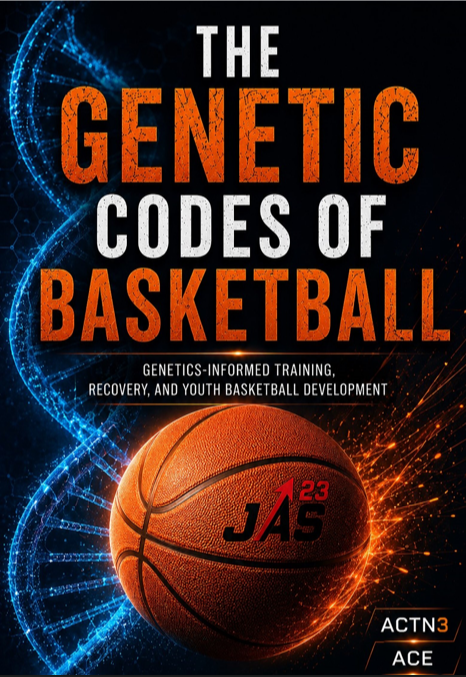
The Genetic Codes of
Basketball
Genetics-informed training, recovery and youth basketball development
Why can two athletes achieve different results from the same training programme? This book explores biological differences alongside practical performance data, ethical responsibility and holistic athlete development.
Turkish e-book · Self-published by the authorTHE SAME PROGRAMME, DIFFERENT RESULTS
Not every athlete responds to the same training
in the same way.
A modern approach to performance considers the whole athlete, from muscle function, energy systems and technical skills to sleep, nutrition, psychology, injury history and the environment in which they train and develop.
Genetics alone cannot provide definitive answers. It can help us ask better questions.
WHO IS IT FOR?
For a deeper understanding of basketball performance.
Basketball coaches
Performance specialists
Sports scientists
Club managers
Athletes and families
Academics
FIVE CORE CONTENT AREAS
From scientific foundations to on-court practice.
Scientific Foundations
DNA, epigenetics, ACTN3, ACE and genotype models
Basketball Performance
Positions, hybrid players, rotation and fatigue
Individualised Development
Training, nutrition, recovery and injury management
Testing and Ethics
Scouting, test reliability, privacy and law
Practical Applications and Future Directions
Case studies, system design and data monitoring
18 CHAPTERS
Comprehensive, practical and grounded in ethical responsibility.
01 Why Genetics and Basketball?
This chapter discusses genetics in the broader context of monitoring training load, recovery and development. It emphasises understanding individual responses to training and developing individualised programmes, while rejecting the use of genetic information to label players.
02 Introduction to Sports Genetics
Some genetic variations may affect protein structure, protein production, metabolic responses or tissue characteristics. These effects are rarely decisive on their own. Performance reflects the interaction of genes, training, environment, developmental stage, nutrition, psychology and coaching.
03 ACTN3 and Muscle Fibre Biology
The best-known variant of the ACTN3 gene is R577X. The R allele is associated with the production of functional alpha-actinin-3, while the X allele is associated with the absence of a functional form of this protein. The presence or absence of alpha-actinin-3 alone does not determine whether someone is a “good athlete” or a “weak athlete”. ACTN3 represents just one aspect of muscle biology.
04 ACE and Cardiovascular Performance
Angiotensin-converting enzyme (ACE) is involved in the renin–angiotensin–aldosterone system, which regulates blood pressure, vascular tone, fluid and electrolyte balance, and circulatory responses. Many studies have examined the ACE I/D polymorphism in relation to ACE activity and endurance performance.
05 Biochemical Map of Nine Genotypes
Considering ACTN3 and ACE together yields nine possible genotype combinations. This chapter uses them to explore hypotheses about explosive power, repeated sprinting, maintaining pace and recovery. For example, it considers whether ACTN3 XX (alpha-actinin-3 deficiency), combined with ACE II, might be associated with more economical muscle function and the ability to sustain concentration and physical resilience late in a game.
06 Basketball Positions
This chapter explores hypotheses about the relationship between genotype, playing position and responses to training load. It considers a player’s biological characteristics alongside the demands of their role on court, while rejecting the use of genotype to select or exclude players.
07 Positionless Players and Hybrid Athleticism
This chapter explores the “hybrid player” as a concept that extends beyond genotype. In modern basketball, a hybrid player combines a broad skill set, quick decision-making, physical adaptability, defensive versatility, a shooting threat, passing ability and training experience.
08 Rotation and In-Game Management
Two players with the same ACE genotype may respond very differently because of their age, conditioning, role, game tempo, injury history, sleep, stress and training background. In-game management should therefore be guided by a monitoring protocol that considers the individual player, rather than by playing time assigned according to genotype.
09 Training Planning
This chapter examines muscle fibre characteristics (ACTN3), metabolic capacity (ACE) and recovery (IL6, SOD2). It explores how these topics relate to training, from the roles of fast- and slow-twitch fibres to aerobic work, short, high-intensity efforts and recovery after exercise.
10 Nutrition Strategies
This chapter explores genotype-specific nutrition (nutrigenetics), focusing on how genetic differences may influence responses to food, vitamins and exercise. The aim is to understand individual metabolic needs and support performance.
11 Recovery and Supercompensation
Two players with the same ACTN3 or ACE profile can recover at very different rates. Relevant factors include sleep duration, increases in training load over the previous 7–14 days, playing time, stress, nutrition, hydration, travel, injury history, stage of growth and development, and psychological state. The book therefore uses a readiness-based decision model rather than prescribing fixed recovery times.
12 Injury Management
Some studies have linked genetic markers such as COL1A1, TNF and CRP to connective tissue characteristics or inflammation. These associations alone are not enough to predict injury. The chapter discusses genetic information in the context of consistent preventive practices and performance development, rather than labelling a player as being at risk.
13 Scouting and Youth Selection
Traditional scouting considers observable factors such as height, coordination, technical skills, game intelligence, physical development, character, competitive behaviour and responses to training. This chapter considers genetic information related to muscle fibre distribution, cardiovascular potential and injury risk as an additional source of information that requires cautious interpretation within long-term development planning.
14 Genetic Tests
Collecting a sample for genetic testing may seem straightforward, but interpreting the results involves serious responsibilities for data security, ethics and legal compliance. Before testing, a club should be able to answer a clear question: “Which decision would this test change?” If it cannot provide an ethically sound answer, it should not proceed.
15 Ethics, Law and Responsibility
Commercial interest in genetics and performance brings risks: labelling people too early, steering children towards predetermined career paths, compromising data privacy and using genetic determinism as a marketing tool. The book therefore focuses on responsible practice and clear boundaries, rather than promoting genetic testing in youth athlete development.
16 International Applications
In the NBA, EuroLeague and other elite basketball organisations, performance management brings together strength and conditioning, athlete health, sleep, nutrition, biomechanics, movement analysis, game workload, on-court tracking and rehabilitation. This chapter focuses on understanding athletes’ existing biological, psychological and environmental characteristics responsibly. It emphasises the quality of training, recovery, nutrition, technical development, psychological preparation and secure data use, while rejecting unethical interventions.
17 Case Studies
“Genotype is potential; phenotype, the outcome that appears, is reality.” The book explores this idea through case studies that illustrate why an athlete’s future cannot be predicted solely from a genetic profile.
18 Practical Guide for Coaches
The practical value of this book lies in helping coaches understand each player more closely. Its approach combines measurement, athlete health, ethical responsibility, data security and individual development planning. It moves beyond both a single programme for every player and training prescriptions based solely on genotype.
SCIENTIFIC AND ETHICAL APPROACH
What does this book support,
and what does it not support?
It supports
- Individualised programmes
- Prioritising practical performance data
- Monitoring individual responses to training
- Consent, privacy and expert assessment
- Ethical, long-term athlete development
It does not support
- Treating a genetic result as proof of talent
- Selecting or labelling children
- Definitive predictions about playing position or success
- Making medical decisions without a specialist
This book is intended for educational and informational purposes and does not replace medical advice or clinical genetic counselling.
PRODUCT OPTIONS
Choose the edition that suits you.
Turkish E-book
Choose your preferred platform.






English Print Edition
Print ISBN 978-625-00-4477-3


English E-book
Choose your preferred platform.

BASKETBALL · PERFORMANCE SCIENCE · ATHLETE DEVELOPMENT
The Genetic Codes of
Basketball
Genetics-informed training, recovery and youth basketball development
Why can two athletes achieve different results from the same training programme? This book explores biological differences alongside practical performance data, ethical responsibility and holistic athlete development.
Turkish e-book · Self-published by the authorTHE SAME PROGRAMME, DIFFERENT RESULTS
Not every athlete responds to the same training
in the same way.
A modern approach to performance considers the whole athlete, from muscle function, energy systems and technical skills to sleep, nutrition, psychology, injury history and the environment in which they train and develop.
Genetics alone cannot provide definitive answers. It can help us ask better questions.
WHO IS IT FOR?
For a deeper understanding of basketball performance.
Basketball coaches
Performance specialists
Sports scientists
Club managers
Athletes and families
Academics
FIVE CORE CONTENT AREAS
From scientific foundations to on-court practice.
Scientific Foundations
DNA, epigenetics, ACTN3, ACE and genotype models
Basketball Performance
Positions, hybrid players, rotation and fatigue
Individualised Development
Training, nutrition, recovery and injury management
Testing and Ethics
Scouting, test reliability, privacy and law
Practical Applications and Future Directions
Case studies, system design and data monitoring
18 CHAPTERS
Comprehensive, practical and grounded in ethical responsibility.
01 Why Genetics and Basketball?
This chapter discusses genetics in the broader context of monitoring training load, recovery and development. It emphasises understanding individual responses to training and developing individualised programmes, while rejecting the use of genetic information to label players.
02 Introduction to Sports Genetics
Some genetic variations may affect protein structure, protein production, metabolic responses or tissue characteristics. These effects are rarely decisive on their own. Performance reflects the interaction of genes, training, environment, developmental stage, nutrition, psychology and coaching.
03 ACTN3 and Muscle Fibre Biology
The best-known variant of the ACTN3 gene is R577X. The R allele is associated with the production of functional alpha-actinin-3, while the X allele is associated with the absence of a functional form of this protein. The presence or absence of alpha-actinin-3 alone does not determine whether someone is a “good athlete” or a “weak athlete”. ACTN3 represents just one aspect of muscle biology.
04 ACE and Cardiovascular Performance
Angiotensin-converting enzyme (ACE) is involved in the renin–angiotensin–aldosterone system, which regulates blood pressure, vascular tone, fluid and electrolyte balance, and circulatory responses. Many studies have examined the ACE I/D polymorphism in relation to ACE activity and endurance performance.
05 Biochemical Map of Nine Genotypes
Considering ACTN3 and ACE together yields nine possible genotype combinations. This chapter uses them to explore hypotheses about explosive power, repeated sprinting, maintaining pace and recovery. For example, it considers whether ACTN3 XX (alpha-actinin-3 deficiency), combined with ACE II, might be associated with more economical muscle function and the ability to sustain concentration and physical resilience late in a game.
06 Basketball Positions
This chapter explores hypotheses about the relationship between genotype, playing position and responses to training load. It considers a player’s biological characteristics alongside the demands of their role on court, while rejecting the use of genotype to select or exclude players.
07 Positionless Players and Hybrid Athleticism
This chapter explores the “hybrid player” as a concept that extends beyond genotype. In modern basketball, a hybrid player combines a broad skill set, quick decision-making, physical adaptability, defensive versatility, a shooting threat, passing ability and an extensive training background.
08 Rotation and In-Game Management
Two players with the same ACE genotype may respond very differently because of their age, conditioning, role, game tempo, injury history, sleep, stress and training background. In-game management should therefore be guided by a monitoring protocol that considers the individual player, rather than by playing time assigned according to genotype.
09 Training Planning
This chapter examines muscle fibre characteristics (ACTN3), metabolic capacity (ACE) and recovery (IL6, SOD2). It explores how these topics relate to training, from the roles of fast- and slow-twitch fibres to aerobic work, short, high-intensity efforts and recovery after exercise.
10 Nutrition Strategies
This chapter explores genotype-specific nutrition (nutrigenetics), focusing on how genetic differences may influence responses to food, vitamins and exercise. The aim is to understand individual metabolic needs and support performance.
11 Recovery and Supercompensation
Two players with the same ACTN3 or ACE profile can recover at very different rates. Relevant factors include sleep duration, increases in training load over the previous 7–14 days, playing time, stress, nutrition, hydration, travel, injury history, stage of growth and development, and psychological state. The book therefore uses a readiness-based decision model rather than prescribing fixed recovery times.
12 Injury Management
Some studies have linked genetic markers such as COL1A1, TNF and CRP to connective tissue characteristics or inflammation. These associations alone are not enough to predict injury. The chapter discusses genetic information in the context of consistent preventive practices and performance development, rather than labelling a player as being at risk.
13 Scouting and Youth Selection
Traditional scouting considers observable factors such as height, coordination, technical skills, game intelligence, physical development, character, competitive behaviour and responses to training. This chapter considers genetic information related to muscle fibre distribution, cardiovascular potential and injury risk as an additional source of information that requires cautious interpretation within long-term development planning.
14 Genetic Tests
Collecting a sample for genetic testing may seem straightforward, but interpreting the results involves serious responsibilities for data security, ethics and legal compliance. Before testing, a club should be able to answer a clear question: “Which decision would this test change?” If it cannot provide an ethically sound answer, it should not proceed.
15 Ethics, Law and Responsibility
Commercial interest in genetics and performance brings risks: labelling people too early, steering children towards predetermined career paths, compromising data privacy and using genetic determinism as a marketing tool. The book therefore focuses on responsible practice and clear boundaries, rather than promoting genetic testing in youth athlete development.
16 International Applications
In the NBA, EuroLeague and other elite basketball organisations, performance management brings together strength and conditioning, athlete health, sleep, nutrition, biomechanics, movement analysis, game workload, on-court tracking and rehabilitation. This chapter focuses on understanding athletes’ existing biological, psychological and environmental characteristics responsibly. It emphasises the quality of training, recovery, nutrition, technical development, psychological preparation and secure data use, while rejecting unethical interventions.
17 Case Studies
“Genotype is potential; phenotype, the outcome that appears, is reality.” The book explores this idea through case studies that illustrate why an athlete’s future cannot be predicted solely from a genetic profile.
18 Practical Guide for Coaches
The practical value of this book lies in helping coaches understand each player more closely. Its approach combines measurement, athlete health, ethical responsibility, data security and individual development planning. It moves beyond both a single programme for every player and training prescriptions based solely on genotype.
SCIENTIFIC AND ETHICAL APPROACH
What does this book support,
and what does it not support?
It supports
- Individualised programmes
- Prioritising practical performance data
- Monitoring individual responses to training
- Consent, privacy and expert assessment
- Ethical, long-term athlete development
It does not support
- Treating a genetic result as proof of talent
- Selecting or labelling children
- Definitive predictions about playing position or success
- Making medical decisions without a specialist
This book is intended for educational and informational purposes and does not replace medical advice or clinical genetic counselling.
PRODUCT OPTIONS
Choose the edition that suits you.
Turkish E-book
Choose your preferred platform.
View prices on each platform. Turkish Print Edition
Printing, ISBN and delivery details are being confirmed.
Coming SoonEnglish E-book
Choose your preferred platform.
View prices on each platform. Books · Turkish & English
Basketball development
in two languages
across two editions.
Two editions exploring youth athlete development, individual differences, training, recovery and education from a responsible, long-term perspective.
Two Editions · One Responsible Approach
An approach that considers the full picture of athlete development.
Both editions place performance data within the wider context of training, environment, education and long-term development. They do not present it as a guarantee of success or a standalone tool for selecting talent.
Turkish Edition
Basketbolun
Genetik Kodları
A comprehensive Turkish-language exploration of basketball development, covering individual differences, training, recovery, education and long-term planning.
International E-book
The Genetic Codes
of Basketball
An English-language edition exploring genetics-informed training, recovery and youth basketball development.
Content Map
Four connected themes across 18 chapters.
Individual Differences
A framework for understanding why athletes can respond differently to the same training.
Training & Recovery
An integrated approach to workload, recovery and sustainable performance.
Youth Athlete Development
A focus on long-term development, education and guidance, rather than premature judgements.
Ethics & Responsibility
A responsible approach that clearly explains the limitations of genetic and performance data.
Publishing · Media · Interviews